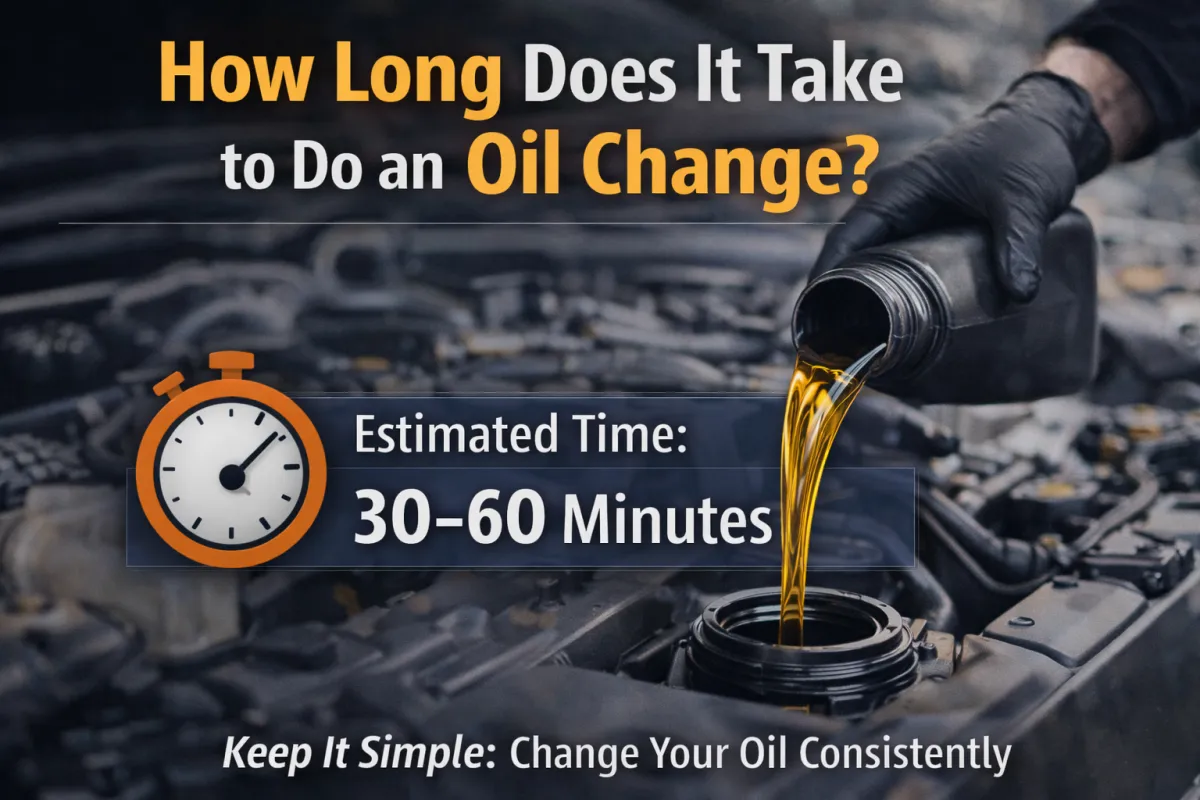
How Long Does It Take to Do an Oil Change?
If you’re trying to plan your day, the real question isn’t just “how long does it take to do an oil change?”—it’s how long will my oil change take based on my vehicle, my driving, and what the shop actually does during the service.
In most cases, you’re looking at 15–60 minutes at a shop (plus any wait time). DIY can be 45–120 minutes depending on your setup and experience.
But here’s my Calgary take: the “time” doesn’t matter if the job is rushed. The shortcuts are what cost engines.
Before we get into the time breakdown, here are the 3 oil-change “hot takes” I’ll stand on for Calgary drivers:
Time matters as much as km in Calgary. Cold starts + short trips load oil with moisture/fuel faster than people think. You can be “low-km” and still be overdue.
Most oil-change disasters are install mistakes, not “bad oil.” Wrong filter, double-gasket, over/under-fill, stripped drain plug, missing sealing washer, no leak check after the first run—this is where engines get hurt.
Correct spec + a quality filter beats “premium oil” with sloppy work every time. Viscosity/spec + correct filter + correct sealing hardware matters more than the brand on the jug.
What Factors Affect the Duration of an Oil Change?

Oil-change time isn’t one number. It’s a mix of vehicle access + service steps + how busy the shop is. Here’s what actually changes the clock:
1) Wait time vs “hands-on” time
A quick lube might finish fast once they start, but your total visit can balloon if it’s busy. Same with any shop.
2) Your vehicle’s design (access is everything)
Some vehicles have filters and drain plugs that are simple to reach. Others have:
skid plates/undertrays
tight filter locations
cartridge-style filters with special housings
All of that adds time—especially if the shop is doing it correctly.
3) Vehicle size and oil capacity
Bigger engines often mean more oil, more time to drain/refill, and sometimes more steps to access everything.
4) Oil type (what it changes—and what it doesn’t)
Synthetic flows better in cold weather, which can help draining in winter conditions. But the bigger truth is this:
synthetic vs conventional usually doesn’t change the service time much because you still have to drain, filter, refill, and verify.
5) What’s included in the service
If a shop is doing it right, an oil change should include more than “dump oil in and send it.” A proper inspection adds time—but it’s often the difference between “just maintenance” and catching a problem early.
Our non-negotiable oil change + inspection checklist (10 items):
Confirm correct oil spec/viscosity for the vehicle (not “one oil fits all”).
Verify the exact filter (correct part # + gasket style) before install.
Replace sealing hardware every time (crush washer / O-ring as required).
Torque drain plug to spec (no impact tools / no “gorilla tight”).
Pre-lube filter gasket + correct filter install (no double-gasket).
Fill to safe level, start engine, check for leaks immediately (plug + filter).
Final oil level re-check after run + settle (top-up to final mark).
Reset maintenance reminder + note next interval (km + date).
Quick “winter-killer” inspection: coolant, battery concerns, belts, visible leaks, tire/brake glance.
Photo notes when needed (leaks, filter/plug area, follow-up items).
That checklist doesn’t exist to slow things down—it exists to prevent the expensive mistakes.
Why Do Repair Shops Take Longer Than Quick Lube Shops?

Quick lube shops are built for speed. Their systems, bays, and workflow are designed to move vehicles through fast.
A full-service shop often takes longer because they’re more likely to:
do a multi-point inspection
check other fluids and obvious safety items
document issues properly (especially if something needs attention)
Here’s the trade-off, straight-up:
Quick lube: faster… but you’re trusting that the install is perfect under time pressure.
Full-service shop: may take longer… but you’re more likely to get eyes on the things that actually strand people in Calgary (coolant issues, weak batteries, leaks, borderline brakes/tires).
In a winter city, I’ll take correct + verified over fast + rushed every time.
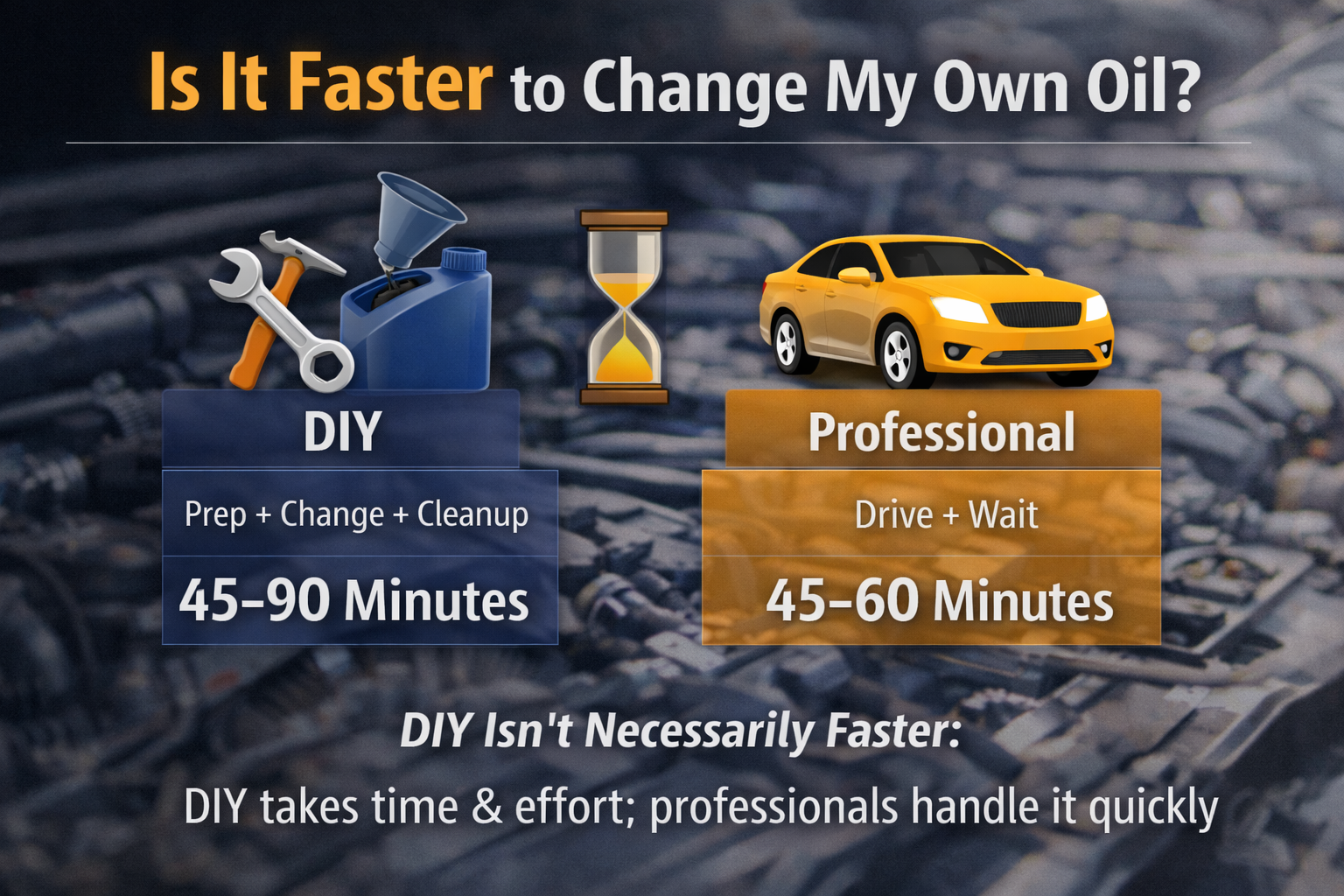
Is It Faster to Change My Own Oil?
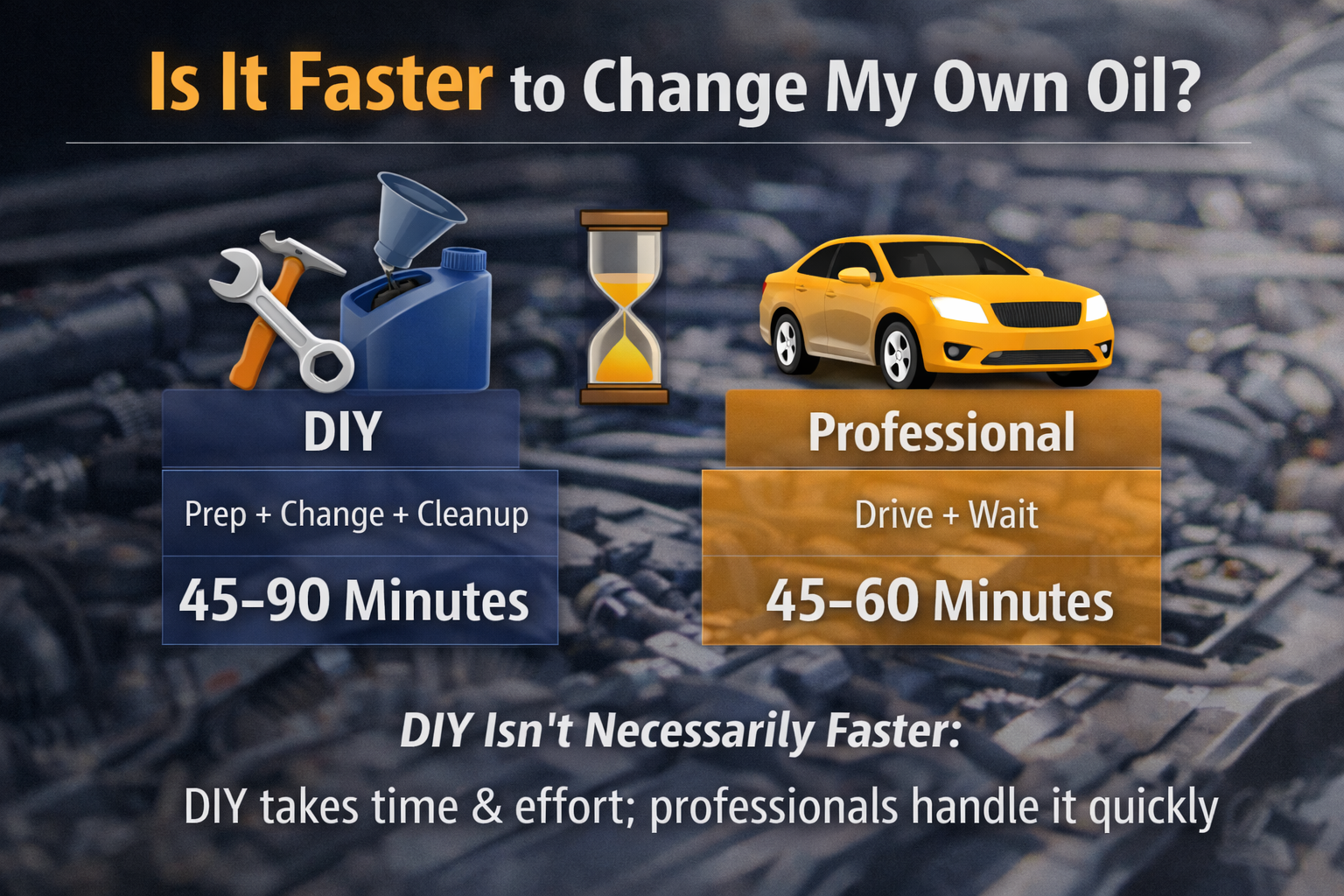
Sometimes yes… but usually no.
If you’re experienced, have the tools laid out, and your vehicle is easy to access, you might finish in about an hour. But for most people, DIY takes longer because of:
setup (jack, stands, safety)
stuck filters or awkward access
cleanup and spills
used oil disposal (which you can’t just “get rid of” casually)
DIY can make sense if you enjoy it and you’re confident. But if you’re doing it to save time, it usually isn’t the best route—especially in winter.
Quick Lube vs. Full-Service Shop: Which Should You Choose?
Choose based on your risk tolerance and what you want out of the visit.
Quick lube makes sense when:
you’re in a rush
your vehicle is straightforward
you’re not relying on the shop to catch anything else
Full-service makes sense when:
you care about catching issues early
you want the oil change treated like a reliability service
you’ve had past problems (leaks, burning oil, high km, winter starting issues)
My Calgary recommendation: if you’re a short-trip driver, have higher mileage, or run a work truck—lean toward a shop that does a real inspection and a post-start leak check.
DIY vs. Professional Oil Change: Which is Better?

This comes down to control vs convenience.
DIY advantages
you control the parts and oil used
you can save on labour
you learn your vehicle
DIY risks
safety (working under a vehicle)
stripped drain plugs, wrong filters, poor sealing
incorrect oil level
missed leaks without a proper post-start inspection
Professional advantages
faster turnaround (especially with an appointment)
proper disposal and cleanup
experienced hands who do this daily
a good shop will catch problems you didn’t come in for
Important: Most of the “oil change horror stories” I see aren’t oil-related. They’re install-related. That’s why process matters.
How Often Should I Change My Oil?
Forget the outdated one-size-fits-all rules. In Calgary, driving conditions matter as much as mileage—sometimes more.
Here are the real-world intervals I recommend:
Daily drivers (mixed city/highway): 6,000–8,000 km or 6 months
Short-trip city drivers (<10 km trips, lots of idling/cold starts): 5,000–6,000 km or 4 months
Highway commuters (steady temps, longer runs): 8,000–10,000 km or 8 months
High-mileage / work trucks (towing, heavy loads, lots of idle): 5,000–7,000 km or 4–6 months
(Tow/idle pushes heat + contamination—shorten the interval rather than “stretching synthetic.”)
And yes—always defer to your owner’s manual if it’s stricter. But in Calgary, short trips can be severe service even when your odometer looks “low.”
What Happens if I Don’t Change My Oil?
Oil doesn’t just “get old.” It gets contaminated.
Over time, oil:
picks up dirt and combustion byproducts
gets diluted with fuel (especially with lots of cold starts)
holds moisture/condensation (short trips make this worse)
thickens and can form sludge in severe cases
When oil can’t protect properly, friction and heat go up. That’s when you start seeing:
accelerated engine wear
sticking components
leaks showing up faster
expensive failures that feel “random” but weren’t
Occasionally pushing past an interval won’t always explode your engine tomorrow—but repeated neglect will absolutely shorten engine life.
The Importance of Regular Oil Changes

A proper oil change is simple preventative maintenance that protects the most expensive part of your vehicle.
But here’s the key: the inspection and the install quality matter as much as the oil itself—especially in Calgary where winter reveals every weak point.
Case Study 1 — Leak caught before it became an engine repair
Vehicle: 2016 Ford F-150 5.0L
KM: 186,000 km
Driving pattern: Short-trip city + lots of cold starts
What we found: Fresh oil seep near the oil filter housing area after the post-start leak check
What we recommended: Reseal/repair the leaking component + clean/degrease and recheck
Outcome: Customer avoided running low between services. Estimated cost avoided: ~$4,000–$7,000 (engine damage risk from low oil)
Case Study 2 — Wrong filter / gasket issue prevented a blowout leak
Vehicle: 2012 Honda Civic 1.8L
KM: 214,000 km
Driving pattern: Daily driver, mixed city/highway
What we found: Incorrect filter + gasket/sealing issue (seep visible) that would likely worsen under pressure/temperature
What we recommended: Correct filter, correct sealing hardware, proper torque + verified no leaks after run
Outcome: Leak stopped immediately. Estimated cost avoided: ~$300–$900 (tow/cleanup/repeat service) and reduced risk of low-oil driving
Those are the wins people don’t think about when they only shop on “how fast can you do it?”
What Type of Oil Do I Need?
Use what the manufacturer calls for—period.
The right oil is defined by:
viscosity (example: 0W-20, 5W-30)
specification/approval (varies by manufacturer and engine design)
capacity (how many litres your engine takes)
In Calgary, cold starts make correct viscosity even more important. But the bigger issue I see is this: people guessing and hoping “close enough” is good.
If you’re not sure, check your owner’s manual—or ask a shop that verifies specs instead of defaulting to “one oil for everything.”
FAQs
1) How long does it take to do an oil change at a shop?
Most shops can complete the service in 15–60 minutes, plus any wait time. Quick lube tends to be faster; full-service shops may take longer because they inspect more.
2) How long does it take to do an oil change myself?
Plan 45–120 minutes, especially if you’re newer, need to lift the vehicle, or your filter is hard to access.
3) Does synthetic oil make an oil change take longer?
Not usually. The steps are the same—drain, filter, refill, verify.
4) Why do some oil changes take longer than others?
Vehicle access, shop workload, added services (inspection/rotation), and whether the shop does a proper post-start leak check.
5) How often should I change my oil in Calgary?
If you do lots of short trips, cold starts, and idling, use a time-based interval too. A practical range is 4–6 months for short-trip drivers, and 6–8 months for many mixed drivers.
6) What’s the biggest mistake people make with oil changes?
Assuming “oil is oil” and ignoring install quality. Wrong filter, double-gasket, missing crush washer, bad torque, no leak check—that’s what causes disasters.
7) Is it bad to go over my oil change interval by a little?
Once in a while won’t always be catastrophic, but repeatedly stretching intervals accelerates wear—especially with Calgary-style short trips.
8) Should I always change the oil filter too?
Yes. A fresh filter helps keep contaminants out of circulation and supports proper oil pressure and flow.
9) What if my oil looks dark—does that mean it’s bad?
Not automatically. Oil darkens as it does its job. The better question is: Are you on schedule, and is the oil level correct? If the oil is gritty/sludgy or the level is low, that’s a problem.
10) Where can I get a fast, correct oil change in Calgary NE?
At Cosmos Customs, our core offer is: $70 Synthetic Oil Change (up to 5L) + Free Inspection. Price may vary for over 5L, specialty oil, or non-standard filters.
Book Your Oil Change
So, how long does it take to do an oil change? In the real world, it’s usually within an hour at a shop—but what matters more is whether it’s done correctly: correct spec, correct filter, new sealing hardware, proper torque, post-start leak check, and a final level re-check.
If you want it done right (and explained clearly),
call/text (587) 966-3425 or book in.
We’re located at 4519 12 St NE Bay #2, Calgary, AB,
open Mon–Sat 9:00 AM–5:00 PM.
