
How Much Does an Oil Change Cost in Calgary?
If you’re searching “how much does oil change cost”, you’re probably trying to answer one of these real questions:
“Am I about to get overcharged?”
“Why is one place $70 and another $150?”
“Is synthetic actually worth it in Calgary?”
“What am I really paying for—oil, filter, labour, or upsells?”
Let’s break it down in plain English with real Calgary pricing ranges, what actually changes the price, and how to avoid the shortcuts that can turn a “cheap oil change” into an expensive engine problem.
And I’ll show you exactly how we do it at Cosmos Customs—because we don’t treat an oil change like a speed contest.
Average Oil Change Cost in Calgary

In Calgary, the price usually comes down to two things:
What oil your engine requires, and
Where you get it done (quick lube vs independent shop vs dealership).
Here are realistic ranges you’ll see around the city:
Quick Lube Centres
Conventional: $40–$70
Synthetic: $70–$90
Independent Auto Repair Shops
Conventional: $60–$80
Synthetic: $80–$100
Dealerships
Conventional: $80–$100
Synthetic: $100–$150
Reality check: those are “typical” ranges. If your vehicle needs more than 5L, Euro-spec oil, or a cartridge filter, it can push higher fast.
What Impacts Oil Change Cost the Most?
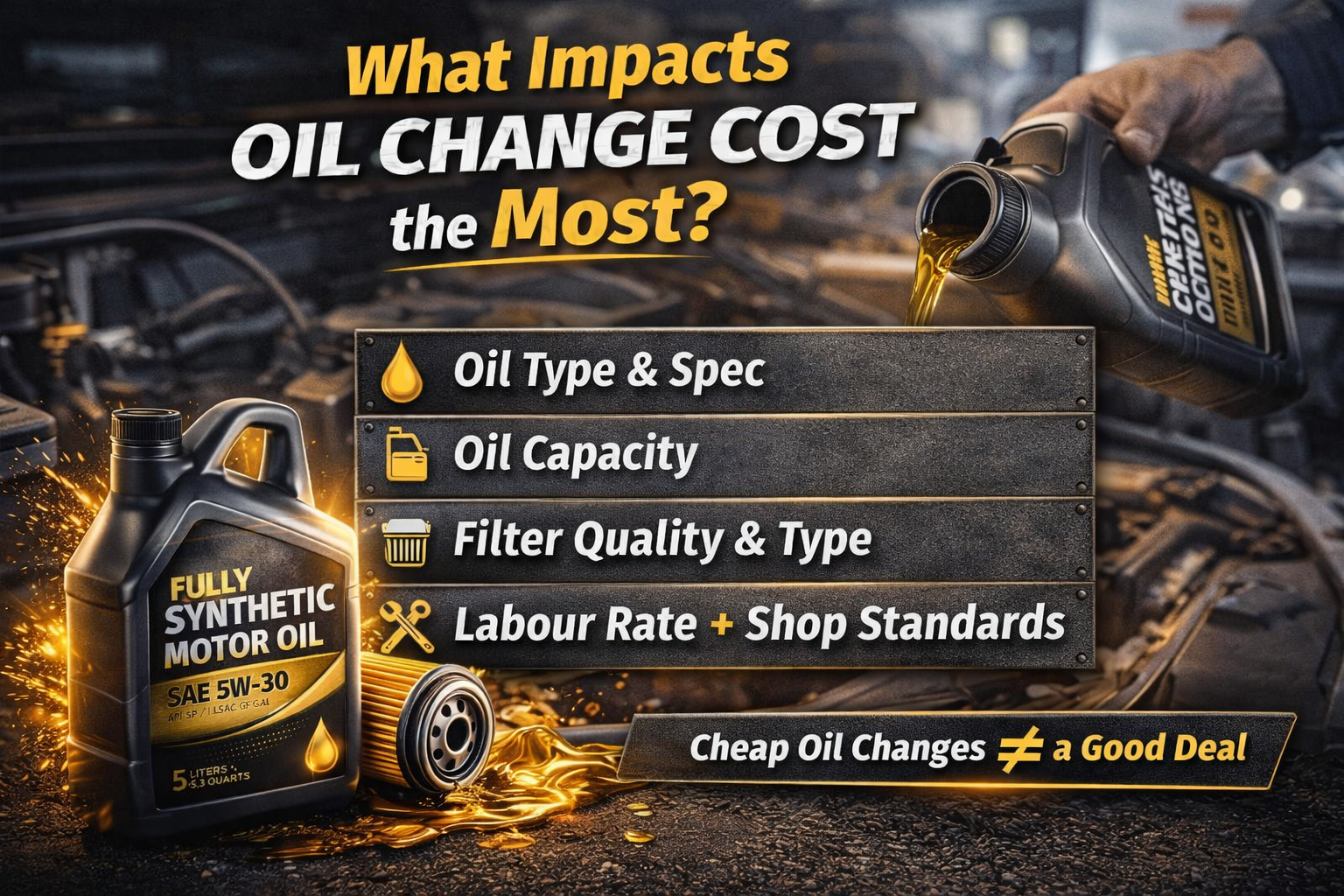
Here’s what actually drives the price (and why two invoices can look totally different).
1) Oil type and oil spec
This is the big one.
Conventional is generally cheaper.
Synthetic blend lands in the middle.
Full synthetic costs more, but usually handles heat/cold better and can support longer intervals (depending on your driving).
Important: “Synthetic” is not one universal thing. Some engines require specific specs (especially many European vehicles). That oil costs more—because it’s different oil.
2) Oil capacity
Some engines take 4–5L, others take 6–10L+. More oil = more cost. Simple.
3) Filter type and quality
A basic spin-on filter is usually straightforward. But:
Some vehicles use cartridge filters
Some require special seals/O-rings
Some cheaper filters cause real problems (more on that below)
4) Labour rate and shop standards
Even if the oil change is “quick,” you’re paying for:
proper installation,
leak checks,
correct torque,
verification the car leaves at the right level,
and someone who will actually own it if something goes wrong.
5) Add-ons and upsells
Some extras are legit (filters, wipers, tire rotation if due). Others are often noise (especially when pushed hard). A good shop explains why something is recommended—without pressure.
Conventional vs Synthetic
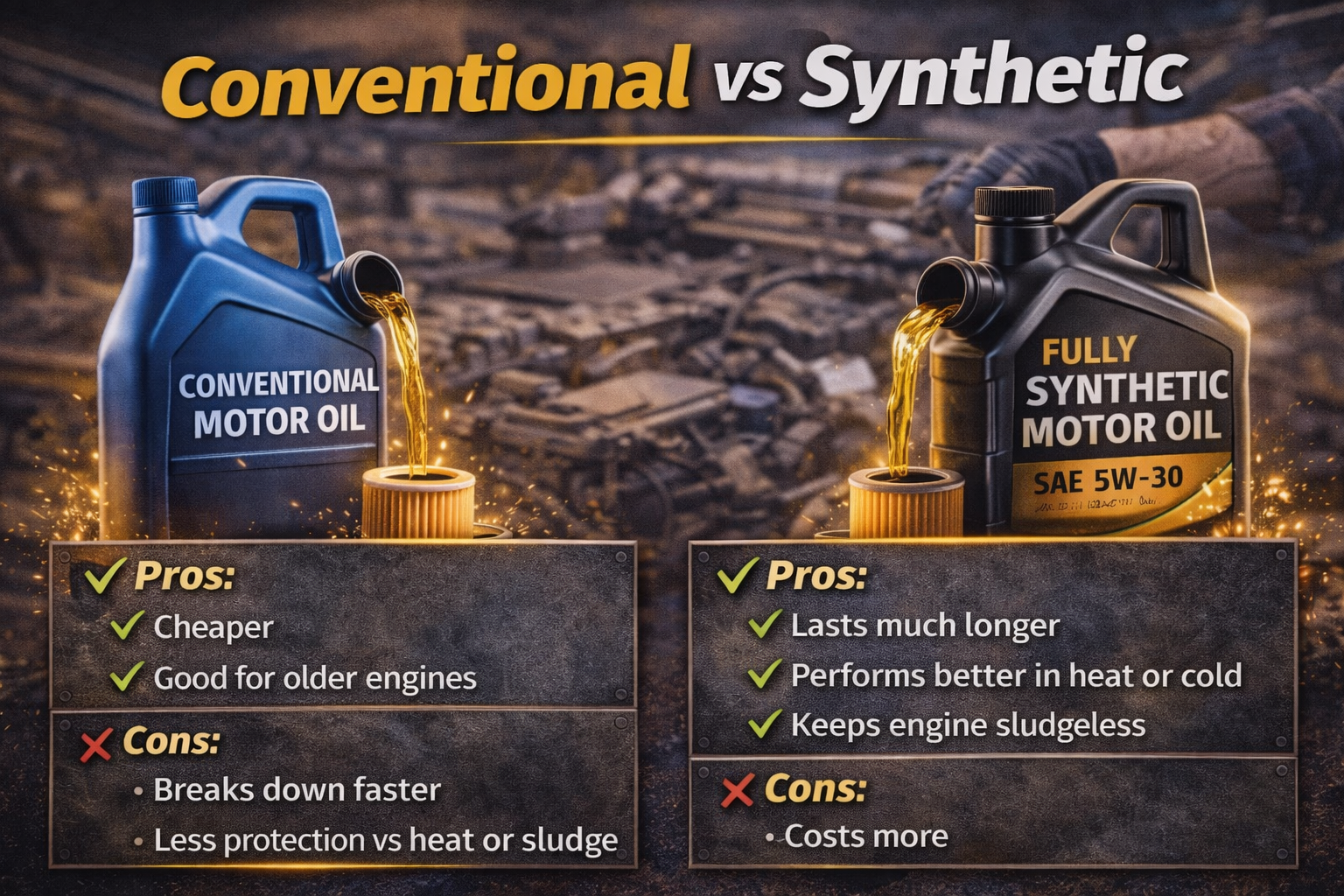
Here’s the simplest way to think about it:
Conventional: cheaper, often shorter change intervals
Synthetic: costs more, generally better protection—especially in temperature swings
For Calgary drivers, I’ll say this straight:
My 3 strongest oil-change opinions (from real shop life)
Cheap oil changes can cost engines—shortcuts are the real danger.
Most problems aren’t “bad oil.” They’re rushed installs: wrong filter, bad seal, stripped plug, over/underfill, or nobody checking for leaks.In Calgary short-trip driving, time can matter more than km.
Cold starts + short drives = moisture + fuel dilution + faster contamination. If your engine doesn’t fully heat-soak regularly, you can’t “stretch it” just because your km are low.The filter matters more than people think.
A bargain filter or wrong fitment can cause bypass issues, poor flow, drain-back problems, or seals that leak out your oil. Filter choice + correct install is a huge part of engine longevity.
Where You Go Matters: Quick Lube vs Independent vs Dealership

Quick lube
Pros: fast, often cheaper
Cons: speed pressure can lead to shortcuts
Independent shop
Pros: often best balance—price + workmanship + accountability
Cons: quality varies (choose a reputable shop)
Dealership
Pros: strong brand process, OEM parts, warranty confidence
Cons: usually costs more
If you’re under warranty, some people prefer dealer history. Others prefer an independent shop that documents everything clearly.
Either way, the goal is the same: correct oil spec + correct filter + correct install + proof it’s done right.
What a Proper Oil Change Should Include
At minimum, you should expect:
Correct oil viscosity + spec for your engine
Oil filter installed correctly (and invoice shows the part used)
New sealing hardware where required (crush washer / O-ring)
Proper torque (not “gorilla-tight”)
Leak check
Final oil level verification after running
Service reminder reset (if applicable)
A quick inspection that actually means something
This is where people get burned: the oil is fine… but the rushed stuff isn’t.
How Often Should You Change Your Oil?

There’s no perfect one-size number. Your owner’s manual wins.
But here’s practical guidance based on how people actually drive in Calgary:
If you do short trips, lots of idling, city driving, or frequent cold starts: plan on the shorter end of the interval.
If you do regular highway driving and fully warm the engine often: you may be okay on the longer end.
Pro tip: If you’re “low km but all short trips,” go by time, not just distance.
DIY Oil Change vs Shop
DIY can save money—if you do it safely and correctly.
DIY pros:
No labour cost
You can shop oil sales
You control the parts
DIY cons:
Disposal hassle (used oil is hazardous waste)
Higher risk of mistakes (wrong filter, double gasket, under/overfill)
No inspection catch unless you do it yourself
If you’re not confident, a reputable shop is worth it—especially if they inspect and document properly.
How to Save Money Without Cutting Corners

Here’s how you save money the smart way:
Shop around, but compare what’s included (oil spec, filter quality, inspection)
Ask if pricing changes over 5L or for special oil/filter requirements
Bundle only what you truly need (tire rotation if due, filters when dirty)
Avoid panic upsells—get a second opinion if it feels off
Use coupons if available, but read fine print
Cosmos Customs Pricing in Calgary NE
Here’s our straight-up approach:
Our anchor offer
$70 Synthetic Oil Change (up to 5L) + Free Inspection
Price may vary for:
over 5L
specialty/Euro spec oil
non-standard filters or cartridge systems
Realistic ranges we can stand behind (transparent + flexible)
Conventional: ~$60–$85 (vehicle dependent)
Full synthetic: $70 promo (up to 5L), commonly ~$90–$150 when over 5L / Euro spec / cartridge filters
High-mileage (synthetic or blend): ~$90–$160 (depends on oil spec + capacity)
What you actually get
Oil + filter with oil grade/spec and filter level shown on the invoice
Proper install: seals/washer where required + correct torque
A meaningful inspection checklist
Service reminder reset (if applicable)
Notes on what’s coming soon—so you can plan, not panic
Real Case Studies From the Shop
Case study #1: “The ‘quick oil change’ that was actually 2L low”
Vehicle: Ford F-150 5.0 (2014)
Km: 212,000
Driving: short trips, lots of idle time, city use
Found: oil level ~2L low + fresh oil mist near the filter area (likely seal/fitment issue)
Fix: correct filter, proper seal, cleanup + warm-idle recheck, tightened follow-up interval
Outcome: prevented a low-oil knock situation that can spiral into major engine damage
Case study #2: “Oil change caught a coolant issue before it overheated”
Vehicle: Honda Civic 1.5T (2017)
Km: 98,000
Driving: daily short commute + cold starts
Found: coolant slightly low + early seepage spotted during inspection (no warning lights yet)
Fix: pressure test + repair seep early, tighter oil intervals due to short-trip use
Outcome: avoided an overheat event (tow + downtime + big risk if ignored)
The Calgary Trust Checklist (Ask These Before You Book)

If you’re choosing between quick lube, independent, or dealer, ask these and look for the answers on the invoice:
What oil spec are you using for my engine (not just “synthetic”)?
What filter brand/part number is going on?
Do you replace the crush washer/O-ring when required?
Do you verify the oil level after running it and checking leaks?
Will you confirm the old filter gasket came off (prevents double-gasket leaks)?
Do you have an inspection checklist—what does it cover?
If you see a leak, do you note where it’s leaking from (not just “leaking”)?
Do you reset the service reminder properly and document the interval?
Do you document the service for warranty/history (date, km, oil spec, filter)?
If something goes wrong (leak/low oil/wrong spec), what’s your process to make it right?
FAQs
How much does an oil change cost in Calgary?
Most Calgary drivers pay $40–$70 (conventional) or $70–$150 (synthetic), depending on oil capacity, oil spec, filter type, and where it’s done.
Why is synthetic sometimes double the price?
Synthetic oil costs more, and many vehicles require specific specs. If your engine takes more oil or needs Euro-spec oil, cost rises quickly.
How long does an oil change take?
Typically 30–60 minutes. At many shops it’s 30–45 minutes, depending on inspection and workload.
Do I really need to change the filter every time?
In most cases, yes. The filter traps debris. A cheap filter or wrong fitment can cause flow/bypass issues or leaks.
Can I just top up oil instead of changing it?
Topping up helps if you’re low, but it doesn’t remove contaminated oil. If your oil is old/dirty, you still need the change.
What’s the biggest mistake people make with oil changes?
Chasing the cheapest price and ignoring workmanship: wrong filter, stripped plug, missing washer, leaks, or incorrect oil spec.
The Real Cost Is “Price + Risk”
If you only remember one thing: the cheapest oil change can become the most expensive when shortcuts happen.
A proper oil change isn’t just pouring oil in. It’s the correct spec, correct filter, correct install, leak check, final verification, and a quick inspection that helps you stay ahead of breakdowns—especially with Calgary cold starts and short-trip driving.
Book Your $70 Oil Change in Calgary NE
$70 Synthetic Oil Change (up to 5L) + Free Inspection
Call: (587) 966-3425
Address: 4519 12 St NE Bay #2, Calgary, AB T2E 4R1
Hours: Mon–Sat 9:00 AM–5:00 PM
Want it done right the first time? Call now or stop by—we’ll get you in, get it done properly, and tell you what your vehicle actually needs (and what it doesn’t).
