How Often Should the Transmission Oil Be Changed? (Calgary/Alberta Guide)
How Often Should the Transmission Oil Be Changed? (Calgary/Alberta Guide)
If you’re searching “how often should the transmission oil be changed”, you’re already ahead of most drivers. Transmission fluid (people call it “transmission oil” all the time) is one of the biggest difference-makers for how long your transmission lasts—especially in Calgary + Alberta, where cold starts, short trips, and big temperature swings beat up fluids faster than most folks expect.
At Cosmos Customs, we keep this simple: we don’t sell “one-size-fits-all” intervals. We recommend the right service at the right time based on your transmission type, your driving pattern, and what the fluid actually looks and smells like.
The practical answer (what most people really want)
For many Calgary drivers, a smart “real-world” interval is:
Traditional automatics: 60,000–80,000 km or ~36 months (daily mixed driving)
CVTs: 40,000–60,000 km or ~24–30 months (daily mixed driving)
But that’s not the whole story—because “severe service” (short trips, winter starts, towing, lots of idling) can cut that interval down significantly.
Why transmission fluid intervals aren’t one number
Transmission fluid has three big jobs:
Lubrication (reduces wear)
Heat control (keeps temps stable)
Hydraulic function (helps the transmission operate and shift properly)
Over time, fluid gets cooked by heat cycles, and it can collect fine debris. That’s why the right interval depends on:
Transmission type (traditional automatic vs CVT)
Service history (maintained vs unknown/neglected)
Driving pattern (short-trip city vs highway vs towing/work)
Symptoms (tiny shift changes are early warnings)
Cosmos Customs “hot takes” we stand on
1) “Lifetime” fluid isn’t lifetime — it’s warranty-lifetime
If you want the transmission to live past the easy years, you service the fluid. Calgary cold starts + short trips + stop-and-go + heat cycles age fluid faster than people think.
2) Flush vs drain-and-fill isn’t a religion — it’s a diagnosis
If the unit has service history and the fluid is decent, a full exchange can be great.
If it’s neglected and the fluid is dark/burnt or loaded with debris, we often go staged: drain-and-fill → recheck → repeat (sometimes with a pan drop first).
3) Tiny shift changes are the early warning system
A little flare, delayed engagement, harsh 2–3, or shudder is the window where you can still save it. Ignore it until it slips, and you’re often already into clutch damage.
Our Calgary-practical transmission fluid change intervals (km + months)
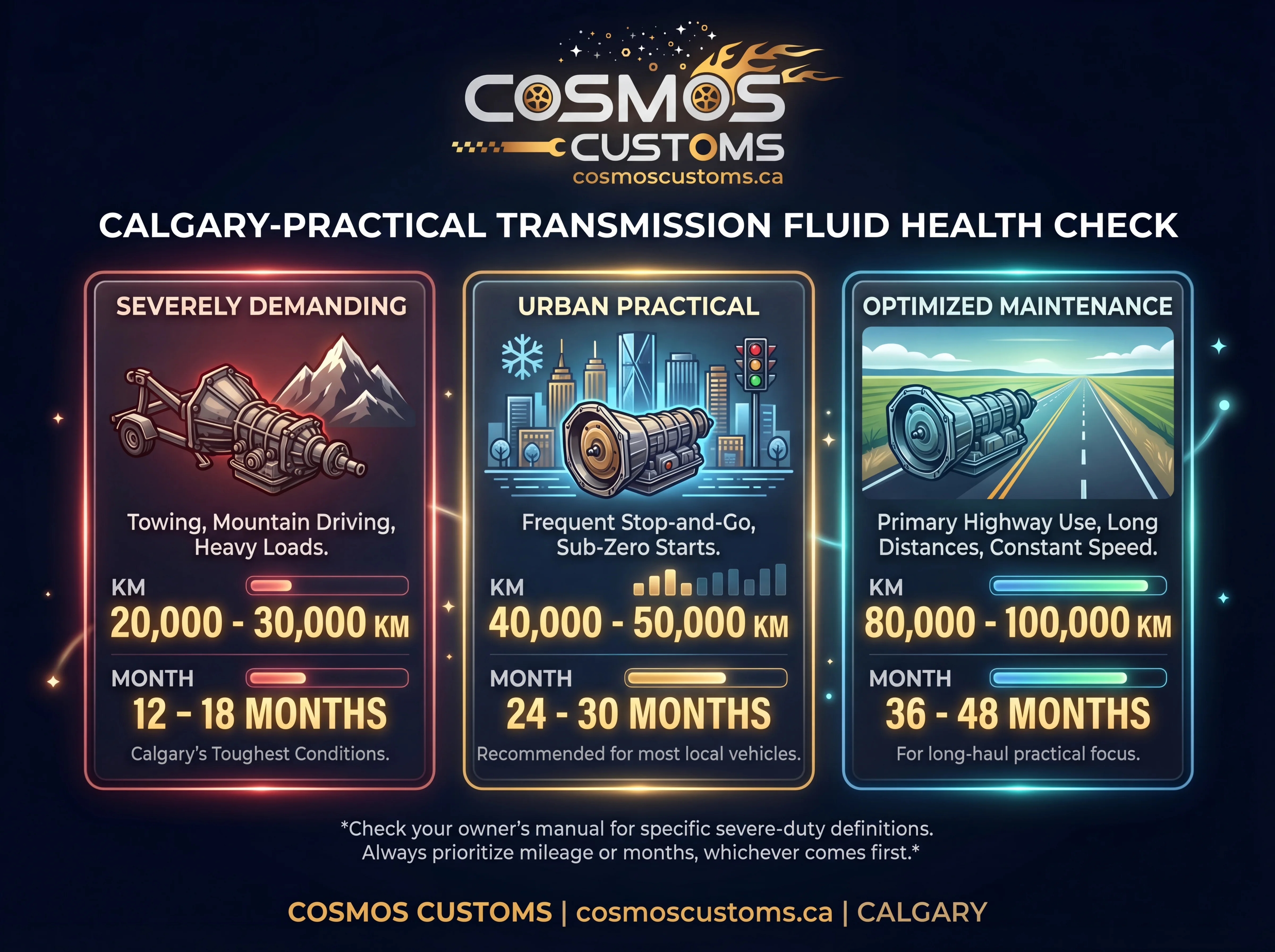
These are designed for Calgary/Alberta reality. If your manufacturer interval is stricter, follow that.
Traditional automatic (most trucks/SUVs/cars)
Daily drivers (mixed city/highway): 60,000–80,000 km or 36 months
Short-trip city (<10 km trips + idling): 40,000–60,000 km or 24–30 months
Highway commuters (steady temps, long runs): 80,000–100,000 km or 48 months
Towing/work trucks (loads + lots of idle): 30,000–50,000 km or 18–24 months
CVT (common in many commuter SUVs/sedans)
Daily drivers: 40,000–60,000 km or 24–30 months
Short-trip city: 30,000–50,000 km or 18–24 months
Highway: 60,000–80,000 km or 36 months
Towing/heavy use: 30,000–40,000 km or 18 months
Simple rule: CVTs are usually less forgiving when fluid gets cooked—so we keep them on the cautious side.
Signs your transmission fluid is overdue (don’t wait for “slipping”)
If you notice any of these, you’re in the “check it now” zone:
Shudder under light throttle or cruising
Delayed engagement (especially cold)
Harsh or inconsistent shifts
Flare between gears
Burning smell / “hot” smell
Leaks under the vehicle
Fluid looks dark/dirty (if your vehicle has a dipstick)
Drain-and-fill vs flush vs staged service (what we actually do)
Here’s the honest breakdown:
Drain-and-fill: Replaces a portion of the fluid. Great as a maintenance step and often the safest start on higher-mileage units with unknown history.
Full exchange/flush (proper machine exchange): Replaces more of the total fluid. Best when the transmission has been maintained and the fluid condition supports it.
Staged approach: Drain-and-fill now → recheck → second service later. This is often the move when fluid is tired and you want to improve it without shocking a neglected unit.
We choose the strategy based on history + symptoms + fluid condition + scan data—not guesswork.
Our non-negotiable transmission service checklist (what quick places skip)
Confirm exact fluid spec by VIN/service info (no “universal” fluid guessing)
Baseline scan + live data check (temps, codes, slip data if available)
Road-test first if symptoms exist (confirm complaint before touching anything)
Fluid condition check (smell, color, contamination indicators)
Choose strategy: drain-and-fill vs staged vs exchange vs pan drop
If serviceable: pan drop, clean magnets, check debris level, inspect gasket surface
Replace filter where applicable (not all units have a serviceable filter)
Correct refill procedure (including temperature-based checks when required)
Adaptations/relearn where applicable (some units are sensitive)
Post-service road test (shift quality + shudder check)
Leak check + final level recheck after warm-up
Document what we saw + recommend next interval
Case studies (real-world outcomes)
Case Study #1 — Towing + dark fluid, saved before it got expensive
Vehicle: Ford F-150 2016 (6-speed auto), 165,000 km
Pattern/complaint: Regular towing. Slight highway shudder + rough 3–4 shift when cold.
What we found: Fluid dark, smelled hot. Pan magnets had moderate paste (no chunks). Temps higher than ideal under load.
What we did: Pan drop + filter + correct-spec fluid service, then scheduled a follow-up drain-and-fill after a short interval.
Outcome: Shudder gone, shifts smoothed out—customer avoided the “drive-it-until-it-slips” zone where rebuild quotes start.
Case Study #2 — CVT shudder caught early
Vehicle: Nissan Rogue 2018 (CVT), 105,000 km
Pattern/complaint: City driving + winter cold starts. Shudder on light acceleration + “rubber-band” feel.
What we found: Fluid darker than it should be; overdue but no catastrophic debris signs.
What we did: Staged approach: drain-and-fill now → recheck → second service to stabilize fluid condition.
Outcome: Shudder improved dramatically after the first service and fully settled after the second—helped avoid the common CVT spiral (ignore → overheat → internal damage).
FAQs: transmission oil change intervals (quick answers)
1) How often should the transmission oil be changed for city driving in Calgary?
Often sooner than highway driving—short trips + cold starts typically push you into the 40,000–60,000 km range (sometimes less for towing/heavy use).
2) Is “lifetime transmission fluid” real?
In practice, it’s usually “lifetime of the warranty.” If you want long-term reliability, plan to service it.
3) Should I flush my transmission or do a drain-and-fill?
It depends on condition and history. Maintained + clean fluid can handle an exchange. Neglected + dark/burnt fluid often does better with a staged approach.
4) How do I know if my transmission fluid is bad?
Dark/burnt smell, shudder, delayed engagement, harsh shifts, and overheating are common red flags.
5) Do CVTs need different service intervals?
Yes—CVTs are often less forgiving when fluid is cooked, so we keep them on a cautious schedule.
6) What happens if I wait until it slips?
Slipping is usually late-stage. Your best chance to prevent major damage is when symptoms are still “small.”
7) Do you always replace the filter?
If the transmission has a serviceable filter, yes—because restriction can cause fluid starvation.
8) Can the wrong fluid cause problems?
Absolutely. That’s why we confirm fluid spec by VIN and avoid “universal” guessing.
9) How long does a transmission fluid service take?
Depends on the service type (simple drain-fill vs pan drop vs exchange), but we plan around doing it properly with road tests and level checks.
10) Is transmission service worth it financially?
Yes—fluid service is cheap compared to transmission repair or replacement.
the “Cosmos Customs” way to think about it
If you only remember one thing: don’t chase a generic interval—match the service to the condition. Calgary driving is hard on transmissions, and the earlier you act (when shift changes are small), the better your odds of avoiding expensive problems.
Book a Transmission Fluid Health Check in Calgary NE
Transmission Fluid Health Check + Service Plan
We’ll verify the correct spec, check condition, look at scan data, and recommend the right service style (drain-and-fill vs staged vs exchange vs pan drop) based on facts—not guesswork.
Cosmos Customs -Project Breif
Call Now: (587) 966-3425
Shop: 4519 12 St NE Bay #2, Calgary, AB T2E 4R1
Hours: Mon–Sat, 9:00 AM–5:00 PM
Secondary options: Book Appointment • Get a Quick Estimate
