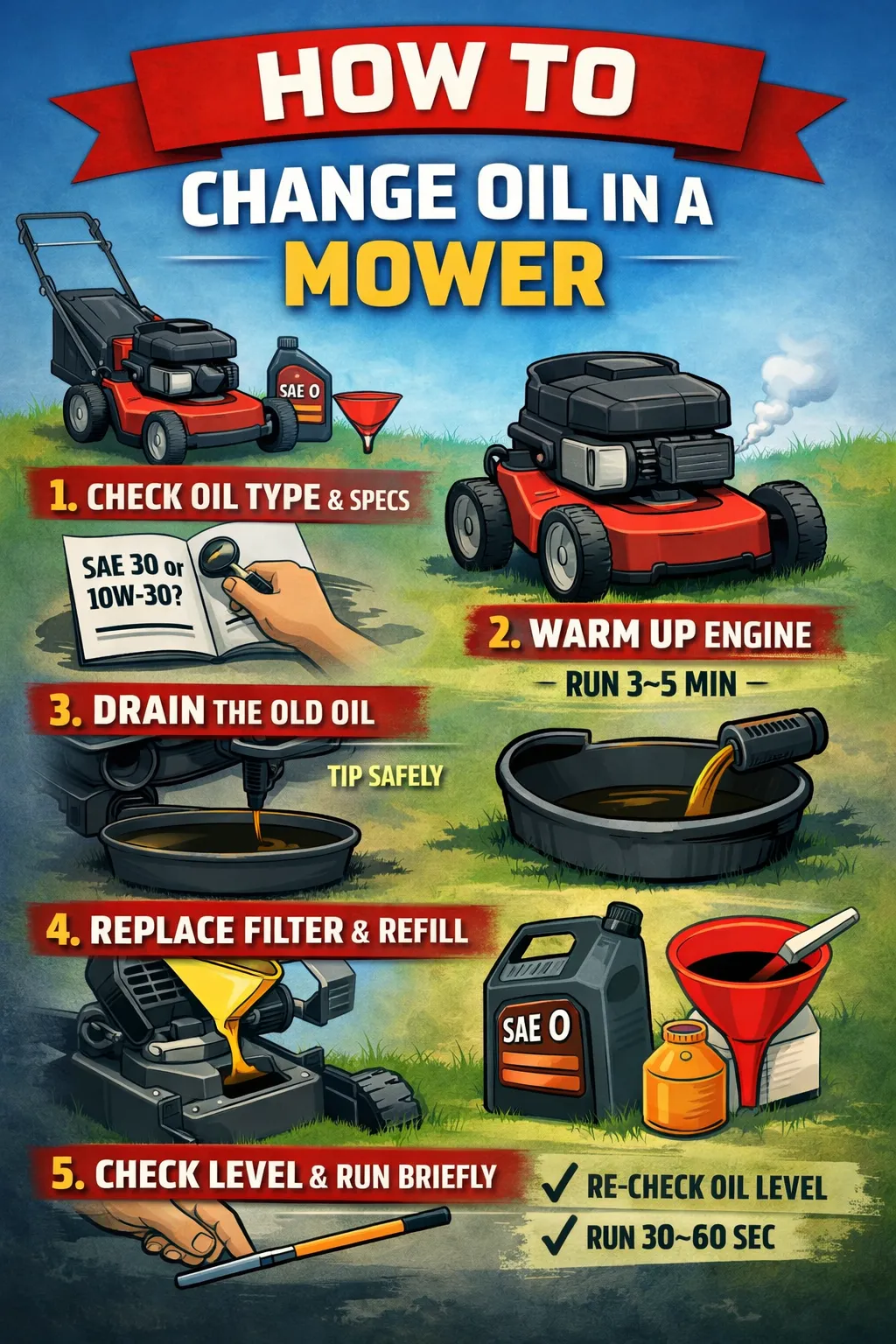
How to Change Oil in a Mower
If you live in Calgary (especially the NE) you already know the combo: dust, short mowing season, and long storage winters. That’s exactly why mower oil changes get people—your mower can rack up a lot of hard hours in a short summer, then sit for months. Do the oil right, and it starts clean every spring. Skip it (or do it wrong), and you’ll be chasing smoke, surging, hard starts, and “it ran fine last year” headaches.
Who this blog is for (and where)
Where: Alberta (Calgary/Calgary NE focus: dust + storage + short season).
Who it’s for (4 reader buckets):
Homeowners who just want their mower to start every spring
“I never service it” folks (the “it ran fine last year” crowd)
DIY small-engine people (you’ll do it yourself—just want the right method)
Landscapers / heavy-use users (dust, long run times, uptime matters)
3 mower oil-change hot takes I’ll stand on

1) Hours matter more than seasons (most people wait way too long)
A mower can live a brutal life in a short summer—weekly mowing, mulching, heat, dust. If you only change oil “once a season” but you’re stacking hours, you’re late.
2) Overfilling ruins more mowers than “bad oil”
Too much oil can foam, smoke, lose power, push oil into the air filter, and create blow-by that makes the engine feel “tired.” Most “my mower is dying” stories are actually “my mower is overfilled.”
3) Tipping the wrong way wrecks air filters (and causes hard starting + smoke)
Tip it wrong and you can dump oil/fuel into the intake and air filter. Then it runs like garbage and people blame the carb.
Bonus stance: cheap oil is fine if you change it on time and keep it full. Neglect is the real killer.
Real-world oil change intervals (rule of thumb)

These are shop-practical intervals that work for most small engines—always follow your owner’s manual if it’s stricter.
1) Homeowner push mower
First change (new mower): ~5 hours (break-in)
After that: every 25 hours or once per season (spring), whichever comes first
If you mulch heavy / dusty yard: every 15–20 hours
2) Riding mower / lawn tractor
First change: ~5–10 hours (break-in)
After that: every 50 hours or once per season
If you tow, mow big acreage, or run hot: every 30–40 hours
3) Commercial / dusty use (landscapers)
Oil change: every 25–50 hours depending on dust/heat/loa
Air filter checks: weekly (or even daily in dust). Dirty filters make engines run rich, lose power, and contaminate oil faster.
Season timing that actually works
Spring: full service (oil + filter checks)
Mid-season: oil change if you’re in the 25–50 hour range
Fall storage: fuel/stabilizer plan + quick check so spring isn’t a nightmare
How to change oil in a mower (step-by-step)
Step 1: Confirm your engine + oil spec (don’t guess)
Check the cap/manual for the recommended oil type (examples you’ll commonly see are SAE 30 or 10W-30 depending on conditions). If your mower has a dipstick, also confirm whether it’s meant to be checked threaded in or rested on—some engines differ.
Step 2: Warm it up (3–5 minutes)
Warm oil drains faster and carries more contaminants out. You don’t need a long run—just enough to get it flowing.
Step 3: Shut down + spark plug wire OFF (non-negotiable)
Pull the spark plug wire and keep it away from the plug so it can’t accidentally reconnect.
Step 4: Clean around the fill/dipstick
This is the step DIY people skip. Dirt around the fill can fall into the engine and undo the whole point of fresh oil.
Step 5: Drain the oil the right way
You’ll typically drain one of these ways:
Drain plug method (common on many mowers)
Dipstick tube pump/extractor method (clean and controlled)
If tipping is required: tip the mower so the air filter/carb side is up (highest point). That’s how you avoid dumping oil into the intake and soaking the air filter.
Step 6: Inspect the old oil (quick health check)
Look and smell:
Metallic sparkle: potential wear
Fuel smell: possible carb/flooding issue
Milky/watery look: moisture contamination
This isn’t “panic mode,” but it’s useful early warning.
Step 7: Check the air filter (especially if there’s smoke or surging)
If it’s packed with dust, replace/clean it. If it’s oil-soaked, the mower will run poorly until it’s fixed.
Step 8: Refill measured amount (don’t free-pour)
Pour in the correct amount gradually. Overfilling is one of the most common failures we see people create at home.
Step 9: Set the oil level correctly
Use the correct dipstick procedure for your engine (thread in vs rest-on-top). Get the level right—between the marks.
Step 10: Run 30–60 seconds + leak check + re-check level
Start it, let it run briefly, shut it down, and re-check after the oil settles. Top off if needed.
Step 11: Dispose properly
Collect used oil in a sealed container and bring it to a recycling depot or approved drop-off.
2 real case studies (anonymized)

Case 1 — Push mower: “smokes and won’t idle”
Mower/engine: typical 140–160cc homeowner push mower
Age/usage: ~4 seasons, estimated 60–80 hours total
Complaint: smoking, surging, stalls at idle
Found: overfilled oil + oil-soaked air filter (tipped wrong during “oil change”)
What we did: corrected oil level, replaced/cleaned air filter, cleaned intake area, verified proper oil type/level
Outcome: ran clean again—avoided an unnecessary carb replacement or “engine’s done” panic
Case 2 — Riding mower: “lost power, gets hot, sounds loud”
Mower/engine: single-cylinder rider
Age/usage: ~6 seasons, estimated 250–350 hours
Complaint: loss of power under load + louder valve/engine noise
Found: oil extremely dark/low (consumption + never topped up), clogged cooling fins/grass packed around shrouds
What we did: oil change + correct fill, cleaned cooling fins/shrouds, basic inspection for leaks
Outcome: power restored + temps stabilized—likely prevented a cooked engine / early rebuild
The “non-negotiable” oil change checklist (8–12 steps)
Use this as your quick printable standard:
Confirm engine type + oil spec (manual/cap)
Warm engine 3–5 minutes
Shut down + spark plug wire OFF
Clean around fill/dipstick
Drain via plug or pump (no guessing)
If tipping: air filter/carb side up
Inspect old oil (metal sparkle? fuel smell? milky?)
Check air filter (especially if dusty or oil-soaked)
Refill measured amount (no free-pour)
Set level correctly (dipstick method matters)
Run 30–60 seconds + leak check + re-check level
Dispose used oil properly
The mistakes people make most (and how to avoid them)

Not disconnecting the spark plug wire → accidental start risk
Overfilling → smoke, power loss, oil in air filter, blow-by mess
Tipping the wrong way → soaked air filter + hard starting
Wrong viscosity for conditions → poor performance, then “blame the mower”
Skipping the re-check after running → level ends up wrong after circulation
Changing mower oil isn’t complicated—but doing it right is what keeps your mower reliable in Calgary’s dusty, short-season reality. If you remember nothing else: go by hours, don’t overfill, and tip it the safe direction. Those three alone prevent most of the “mower is toast” stories.
If you’re the “I never service it” type, here’s the real question: when was the last time your vehicle got the same level of care? For honest maintenance and a quick inspection in Calgary NE.
call Cosmos Customs at : (587) 966-3425
visit us at : 4519 12 St NE Bay #2, Calgary, AB T2E 4R1
(Mon–Sat 9:00 AM–5:00 PM).
