
Book any of our services today!
Our Latest Articles
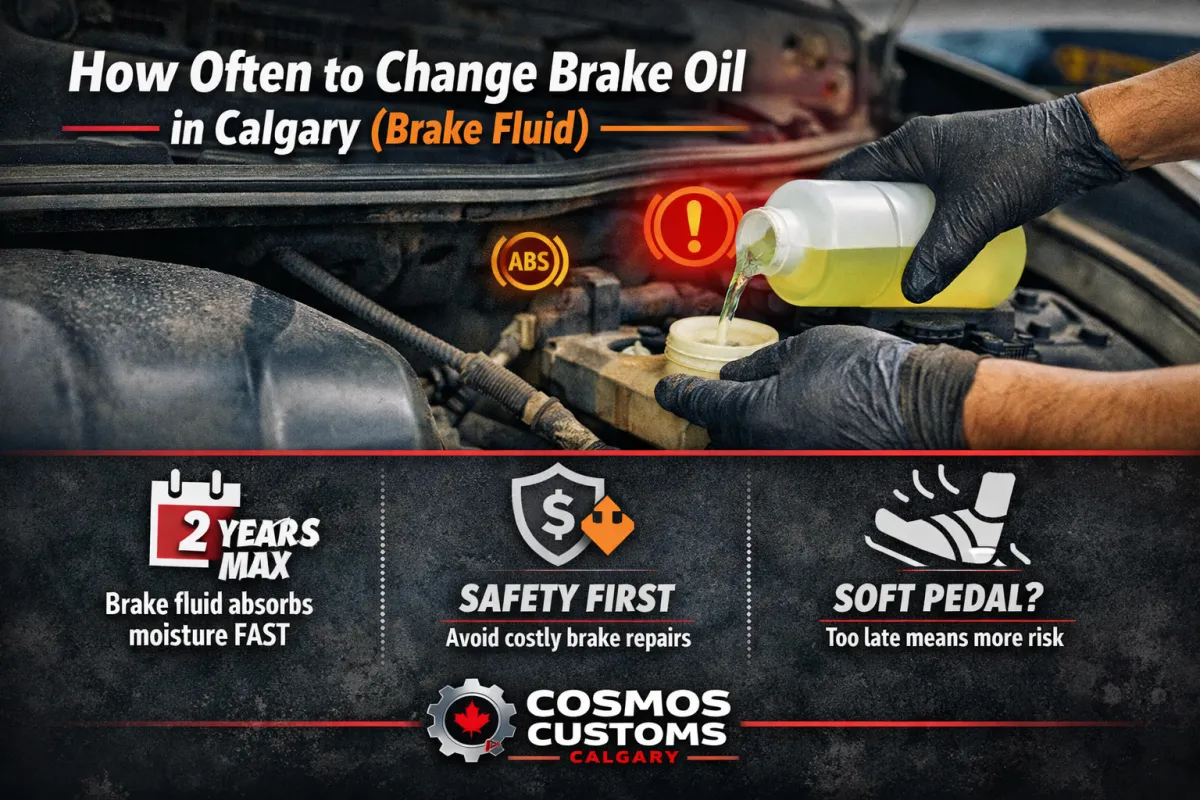
How Often to Change Brake Oil in Calgary (Brake Fluid)
If you Googled “how often to change brake oil”, you’re not alone—people say “brake oil” all the time. What you’re actually talking about is brake fluid: the hydraulic fluid that transfers force from your pedal to your brakes so the vehicle stops—every time, the same way, even when the brakes are hot.
In Calgary and across Alberta, brake fluid gets overlooked because it’s not like engine oil—you don’t see it every week. But it’s one of the most important maintenance items on the car because old brake fluid can change braking performance, especially under heat (long downhills, towing, stop-and-go, winter commutes).
This guide is the straight-up, shop-practical answer—built around how we do it at Cosmos Customs in Calgary NE.
3 brake-fluid “hot takes” for Calgary/Alberta drivers
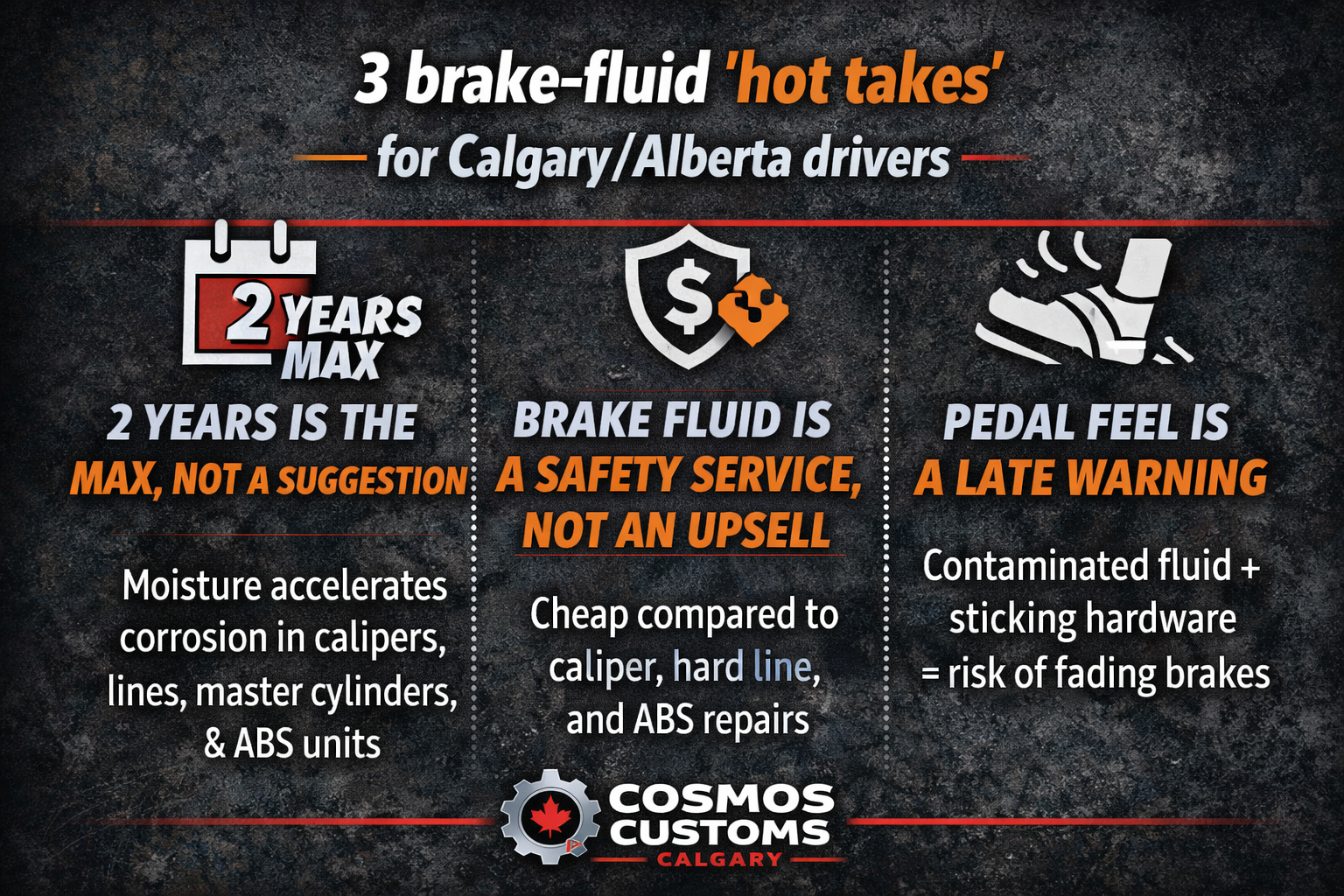
1) “2 years is the max, not a suggestion.”
Brake fluid is hygroscopic
ime. Moisture drops the boiling point and increases corrosion risk inside calipers, hard lines, the master cylinder, and ABS components. That’s why time matters even if your kilometers are low.
2) “Brake fluid is a safety service, not an upsell.”
A proper flush is cheap compared to what neglect can trigger: stuck calipers, seized bleeders, rusty lines, and inconsistent pedal feel when brakes are hot. Even mainstream maintenance guides push the same idea—replace it before it becomes a bigger brake system problem.
3) “Pedal feel is a late warning.”
By the time you notice a softer pedal, longer stopping distance, or fade on a downhill, the fluid is often already contaminated and hardware may already be corroding. The smarter move is test early and service on time.
Real interval recommendations (km + months)
These are the intervals I’d stand behind for Calgary/Alberta driving. Final rule: defer to the manufacturer if they’re stricter (some brands call for 2 years, some 3, some mileage-based).
1) Typical daily drivers
Every 24 months / 30,000–50,000 km (whichever comes first)
2) Heavy braking users
(Downhill routes, towing, rideshare, delivery, frequent stop-and-go)
Every 12–18 months / 20,000–30,000 km
If you regularly see hot brakes (mountain driving, towing): lean 12 months.
3) Older / high-km vehicles
Every 18–24 months / 25,000–40,000 km
Older systems tend to carry more moisture load and corrosion risk—so we often shorten the time interval even if you don’t drive a lot.
Signs your brake oil (fluid) is due

A lot of people wait for a problem—don’t. But if you’re seeing any of these, it’s time for a brake inspection:
Spongy/soft pedal or the pedal doesn’t feel consistent
Longer stopping distance or “doesn’t bite like it used to”
Fade on long downhills (pedal changes under heat)
Brake warning light (don’t guess—inspect it)
Fluid looks dark or murky in the reservoir (not always perfect evidence, but it’s a clue)
Cosmos Customs brake-fluid service process
Here’s our standard so it’s not a “top-up and pray” situation—because topping up isn’t the same as flushing contaminated fluid.
Confirm the correct spec (cap label + service info): usually DOT 3 or DOT 4
We never use DOT 5 silicone unless the vehicle explicitly requires it.
Baseline test (when available):
Moisture % (many shops treat ~3% as a common “replace” threshold)
Copper ppm (helps flag internal corrosion/line degradation)
Inspect before we touch anything: reservoir condition, cap seal, line/hose condition, caliper bleeders for corrosion, and any seepage near the master cylinder/ABS unit.
Protect the vehicle: fender covers, correct catch bottles, keep the reservoir safely managed.
Full flush/bleed at all four corners (not a top-up):
Fresh fluid pushed until clear + bubble-free at each wheel
Correct bleed order + manufacturer procedure
Some vehicles require an ABS service procedure if air is suspected
Pedal verification + leak check: firm pedal, no seepage at bleeders, correct reservoir level and cap seal.
Road test (when safe/appropriate): confirm consistent pedal feel and braking behavior.
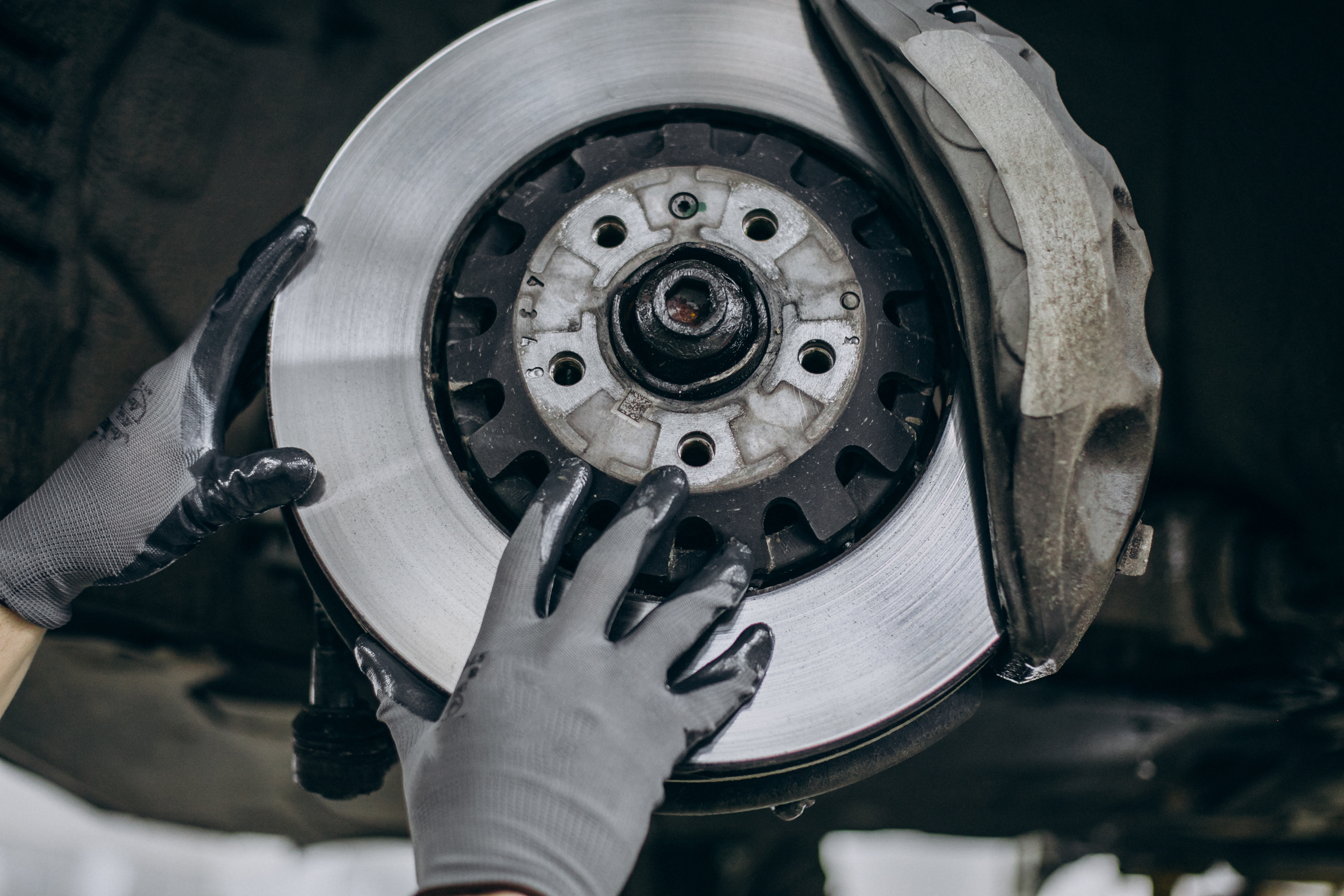
Quick but meaningful brake inspection: pads, rotors, caliper slide movement, hose cracking/bulges, uneven wear (sticking hardware clues).
Document the service: spec used, test results (if done), and a clear next due date.
DOT 3 vs DOT 4
This is simple:
DOT 4 generally has a higher boiling point than DOT 3 (helpful for heat-heavy driving).
Both absorb moisture over time (that’s why time-based service matters).
DOT 3 and DOT 4 are commonly described as compatible, but the correct call is: use what the vehicle spec requires.
If you tow, drive lots of hills, or run your brakes hot, DOT 4 often makes sense when the vehicle allows it—but we still follow your cap/vehicle spec first.
“Is a brake fluid flush worth it?” Real cost vs real risk

Brake fluid service is usually a “small bill” compared to what it protects:
Corroded lines, seized bleeders, sticking calipers, and heat-related braking issues cost way more than routine fluid maintenance.
Calgary market reality (typical ranges):
Many Calgary shops list brake fluid flush pricing around $139–$160+ as a starting point, and it can go higher depending on vehicle and procedure.
At Cosmos Customs, we price it based on the vehicle and what it needs (especially if corrosion makes things slower), but the goal stays the same: do it properly once instead of paying twice later.
Quick case studies you can plug real numbers into
You asked for case studies that feel real without making up shop history. Here are tight, website-ready formats—swap in real RO details as you collect them.
Case 1 — Soft pedal after a downhill
Vehicle/year + km: [2014 Ford Escape] — [198,000 km]
Complaint: soft pedal / fade after long downhill or repeated stops
Found: moisture [3.5%], fluid dark; pads [x mm]; rear caliper slides sticky
Did: DOT [3/4] full flush all corners + serviced slides
Outcome: firmer pedal, reduced fade; likely avoided early caliper wear and uneven pad burn.
Case 2 — Brake warning light / ABS concern
Vehicle/year + km: [2016 Ram 1500] — [142,000 km]
Complaint: intermittent ABS activation / longer stops in winter
Found: moisture [4.0%], copper [>200 ppm]; one bleeder heavily corroded
Did: full flush + replaced [bleeder/caliper if needed] + verified ABS function
Outcome: stabilized braking performance; reduced risk of bigger corrosion-related brake repairs later.
Case 3 — Low-km vehicle, old fluid
Vehicle/year + km: [2019 Civic] — [52,000 km]
Complaint: none (preventive)
Found: moisture [2.8–3.2%] despite low km; fluid darkening
Did: DOT [3/4] flush all corners + full brake inspection
Outcome: keeps system clean, lowers corrosion risk; sets a clean 2-year maintenance rhythm.
FAQs
How often should I change brake oil if I barely drive?
Still follow time. Even low-km vehicles absorb moisture over time. Most guidance lands in the 2–3 year range depending on the manufacturer.
Is brake fluid really a “flush”?
Most shops use “flush” to mean removing old fluid and replacing it with fresh fluid through the system. The important part is: it should be a full service, not a top-up.
What happens if brake fluid gets too wet?
Moisture reduces boiling point and can contribute to corrosion. Under heavy braking, that can show up as fading/changed pedal feel—exactly when you need the brakes most.
Should I use DOT 3 or DOT 4?
Use what your vehicle specifies (cap label / owner’s manual). DOT 4 often has a higher boiling point, but spec comes first.
Can I just top up brake fluid instead?
Topping up fixes level—not contamination. If the fluid is old or moisture-loaded, a top-up doesn’t restore boiling point or corrosion protection.

If you want the cleanest answer to “how often to change brake oil” in Calgary: every 2 years max for most drivers, sooner if you tow, drive hills, or cook your brakes in stop-and-go. Brake fluid is hygroscopic, and in the real world, time is the enemy even when kilometers are low.
If you’d rather not guess, Cosmos Customs can inspect your brake system, test the fluid (when available), and do a proper full flush—not a top-up—so you know your brakes will feel the same when they’re cold, hot, and everything in between.
Address: 4519 12 St NE Bay #2, Calgary, AB T2E 4R1
Phone: (587) 966-3425
Hours: Monday–Saturday 9:00 AM–5:00 PM
Call now to book your brake fluid service or get a quick estimate.

We’re dedicated to keeping you safe on the road with top-quality tires and expert service. Visit us for all your tire needs and experience the difference. Drive confidently, knowing we’ve got you covered every mile of the way.


